

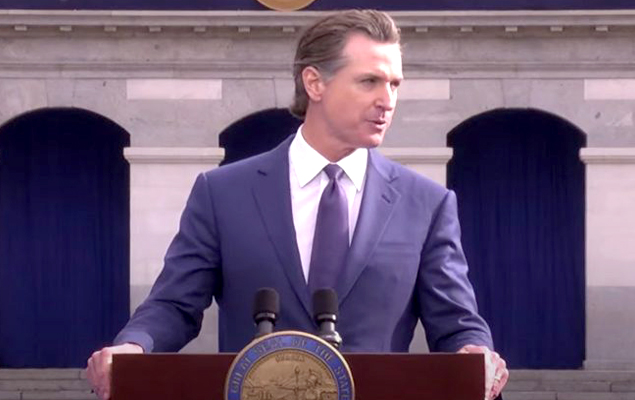
The California governor’s new podcast, where he broke with Democrats on trans rights, triggered a media firestorm and evoked a variety of opinions from Californians.
When I saw the headlines about Gov. Gavin Newsom’s new podcast, “This is Gavin Newsom,” I rolled my eyes.
Media outlets buzzed with criticism. He was pandering to the right, giving platforms to extremists and abandoning Democratic values. Featuring far-right figures like Steve Bannon and Charlie Kirk felt like a betrayal — not just of progressive ideals, but of the communities Newsom had once fiercely championed.
As a California voter, I felt let down. I’ve marched for women’s rights, knocked on doors for state lawmakers and even stayed politically engaged while living out-of-state. I once believed in Newsom’s vision: flawed but fearless. But lately, his leadership feels like it’s pivoting toward national optics, not California needs.
So when I heard about the podcast, I assumed the worst. Before listening, the headlines read: “Newsom flip-flops on trans rights.” I was furious. It was surely another calculated move toward a bigger stage, or another politician trading values for visibility.
Then, I listened.
What I found wasn’t capitulation. It was a conversation. Newsom wasn’t yielding ground — he was entering the arena, however imperfectly. In a tense exchange with Kirk, the two sparred
But when I heard him say, “Some of these things are more nuanced than we want to acknowledge. I get why people are concerned about fairness. I don’t think it’s transphobic to say that,” I paused.
That didn’t sound like betrayal. It sounded like someone trying to hold space for a hard conversation.
I’m not saying people should validate harmful rhetoric. But there’s a difference between giving in and digging in. Leaning into nuance and listening to what’s actually said, not just the loudest headline.
Newsom didn’t land every punch, but he showed up in the ring.
The real gut check came when a friend asked me if I listened to the whole thing. I hadn’t. I’d gone off the headlines. I always tell others to check their sources, dig deeper and avoid outrage as a substitute for understanding. And yet, I’d done exactly that.
In today’s media climate, that’s easy to do. A lot of headlines aren’t designed to inform — they’re crafted to provoke. And in a world of constant alerts, who has the time?
But this podcast reminded me that headlines are the hook, not the whole fight. We have to stop shadowboxing. We have to listen.
Ironically, the podcast’s critics only amplified its reach. Right-wing outrage helped boost Newsom’s visibility, intentionally or not. It echoed Trump-era dynamics of controversy as fuel and attention as currency. It made me wonder if we’re all playing into the same script, feeding the spectacle we claim to despise.
But here’s what matters: Newsom engaged. He challenged the binary narratives that dominate political discourse. He didn’t have all the answers, but he asked the questions. That kind of engagement doesn’t signal weakness. It signals a shift toward dialogue, not division.
In my own policy work, I’ve learned that compromise isn’t everyone getting what they want. It’s about understanding what people are willing to give up and why. That requires listening past the surface, asking deeper questions and staying at the table even when it’s uncomfortable.
As sociologist Pierre Bourdieu wrote, “A political compromise is not the negation of struggle, but its transformation into a more strategic form.”
I judged the podcast before I heard it. In doing so, I nearly missed a model for the kind of political discourse we desperately need — one grounded not in performative outrage but in curiosity, respect and the belief that progress lies, not on the extremes, but somewhere in the messy middle.
The original version of this article was published on calmatters.org.